Roll Vibes
Early-stage startup: AI-powered, geolocated music events app. Product Designer and Product Manager.
- Type
- Web, Mobile
- Industry
- Music, Events
- Company
- Roll Vibes
- Country
- Spain
- Year
- 2026
The challenge
Every week hundreds of concerts and events go undiscovered: the information is scattered, outdated or buried in social media.
The strategy
Roll is a geolocated music-events discovery app with collaborative publishing. At its core is an AI agent that automatically scrapes events from Spanish websites and publishes them in the app — always-fresh content, no manual management. My role: Product Manager and Product Designer. In 2026, powered by AI, I am taking Roll from a shelved idea to production.
The outcome
MVP nearly complete · 2026.
Process · Design Thinking
- Research: Hundreds of live-music events every week that nobody discovers because the info is scattered and outdated. A problem I had already spotted when I founded Roll in 2018.
- Ideation: A geolocated events discovery app with collaborative publishing, plus an AI agent that keeps content always fresh with no manual work.
- Sketching: I designed the full experience —event map, collaborative publishing, saved collection— and the roadmap to MVP.
- Prototype: Built entirely with AI; I implemented the agent that scrapes events from Spanish websites and publishes them automatically.
- Testing: MVP nearly complete, tuning the data pipeline reliability before production. 2026.
AI Product Designer / AI Product Manager
Product Discovery - UX Research - Design Thinking - Prototyping in Figma - Design system - Roadmap - Funnels and analytics - SEO - Pricing - AI products
Research: Roll Vibes research: users, benchmark and venues
User interviews, a benchmark of six platforms and interviews with four bars in Salamanca to find the problem and validate the price.
The problem
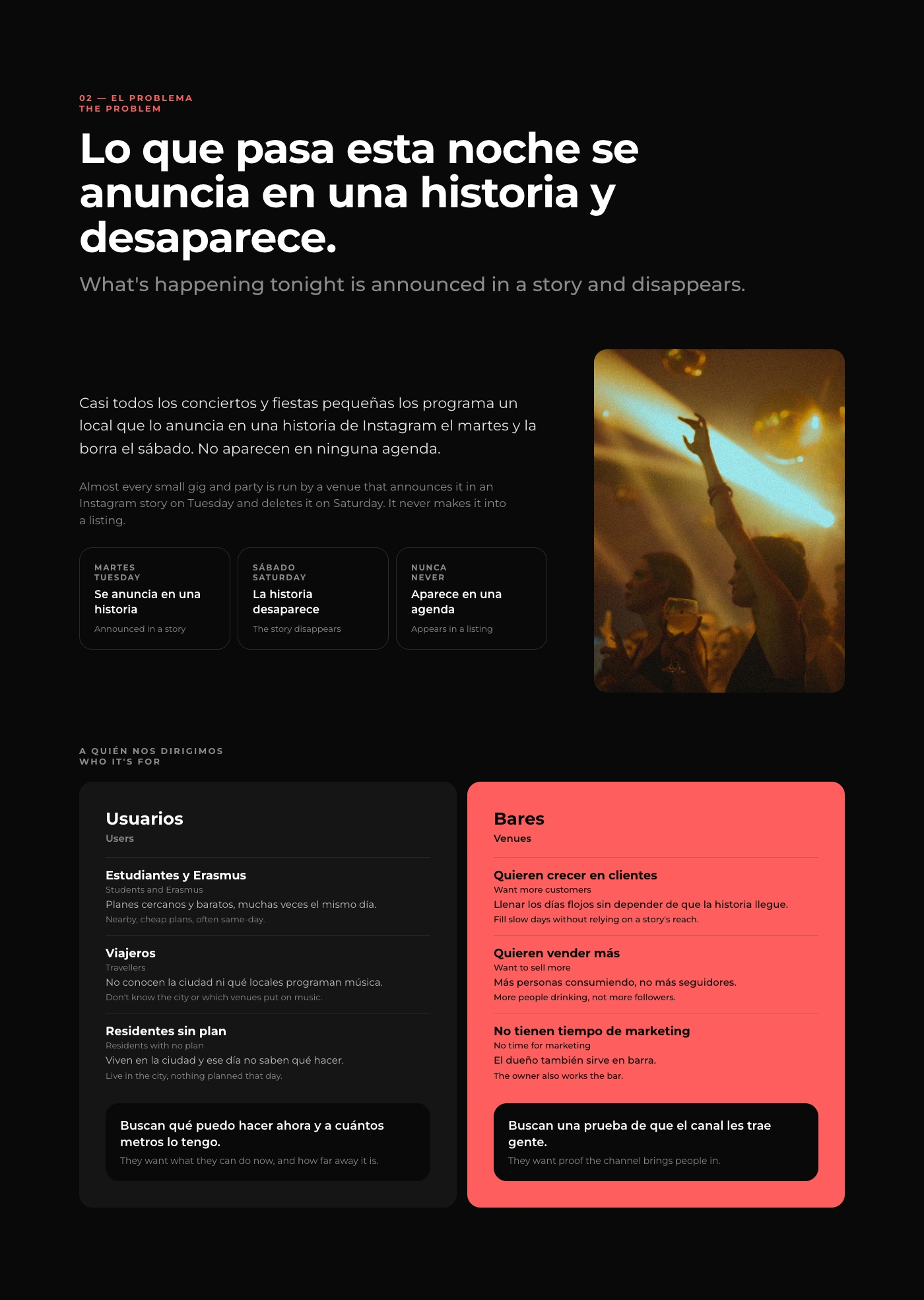
Almost every small gig and party is run by a venue that announces it in an Instagram story and deletes it: it never makes it into a listing. Users want what they can do now and how far away it is; venues want proof that the channel brings people in.
User interviews
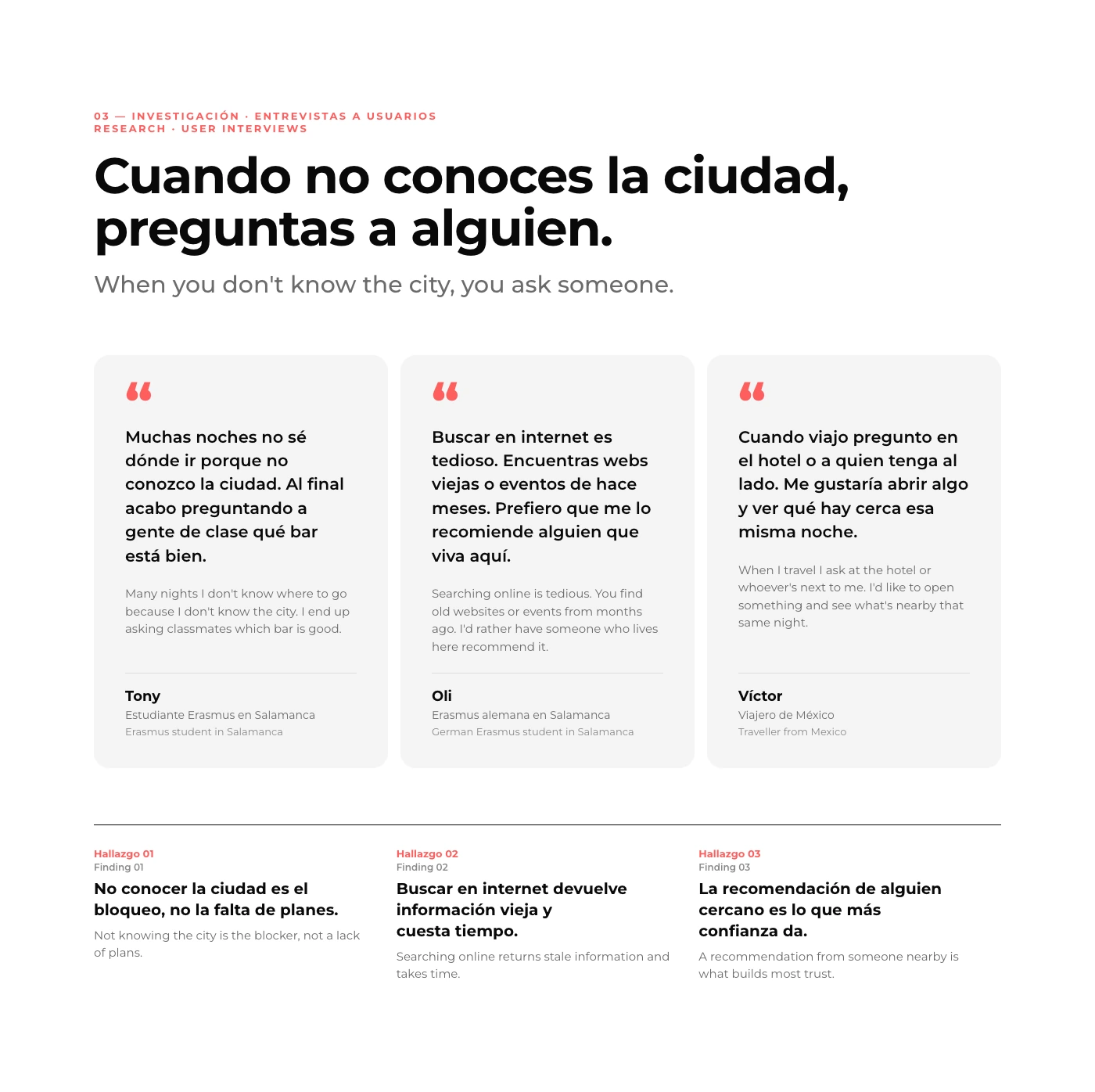
Interviews with Erasmus students and travellers. Three findings: not knowing the city is the blocker, searching online returns stale information and takes time, and a recommendation from someone nearby is what builds most trust.
Benchmark and venue interviews
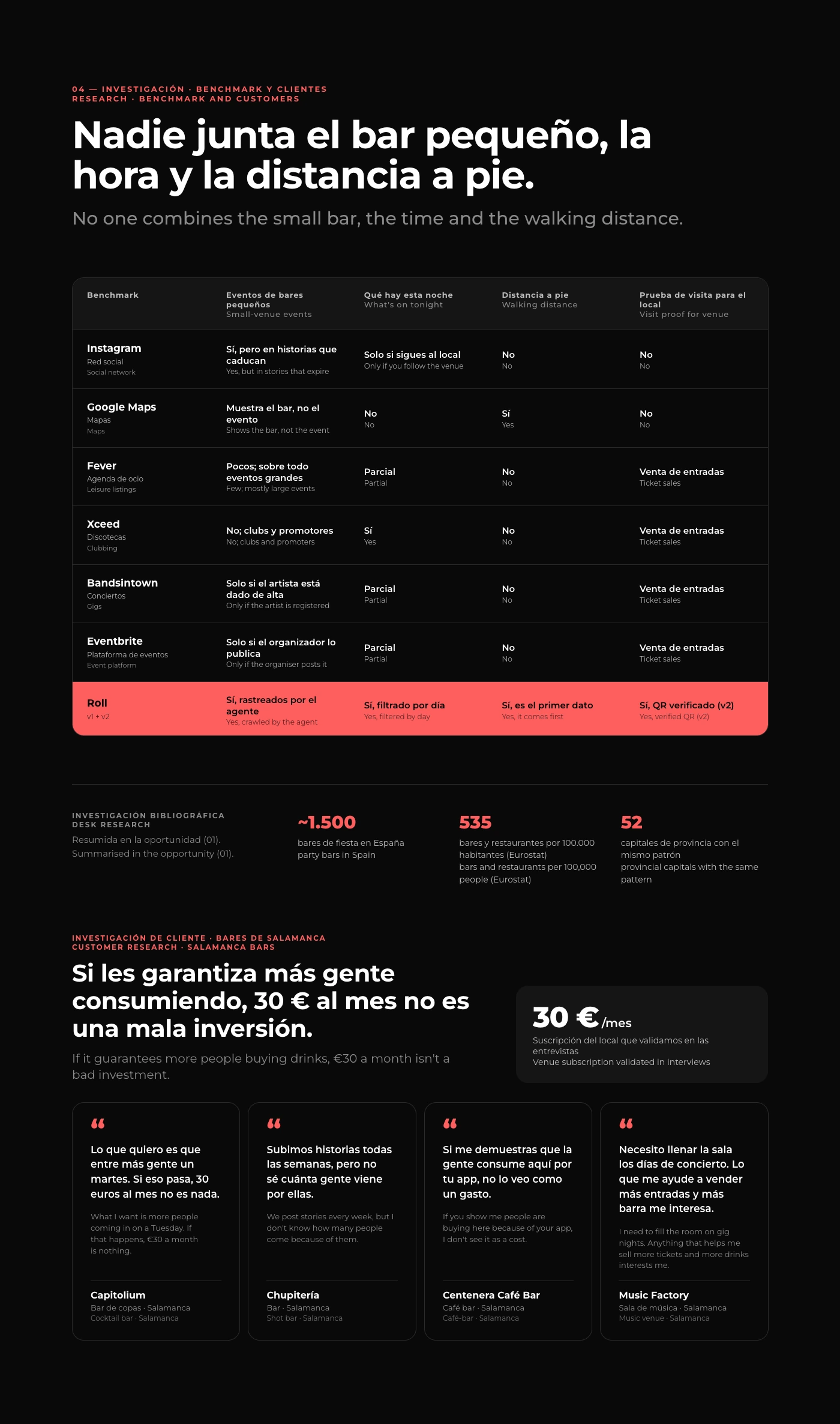
No alternative combines the small bar, the time and the walking distance. Interviews with four bars in Salamanca validated a €30 monthly subscription if the channel proves it brings in paying customers.
User flow: Roll Vibes user flow: user and venue
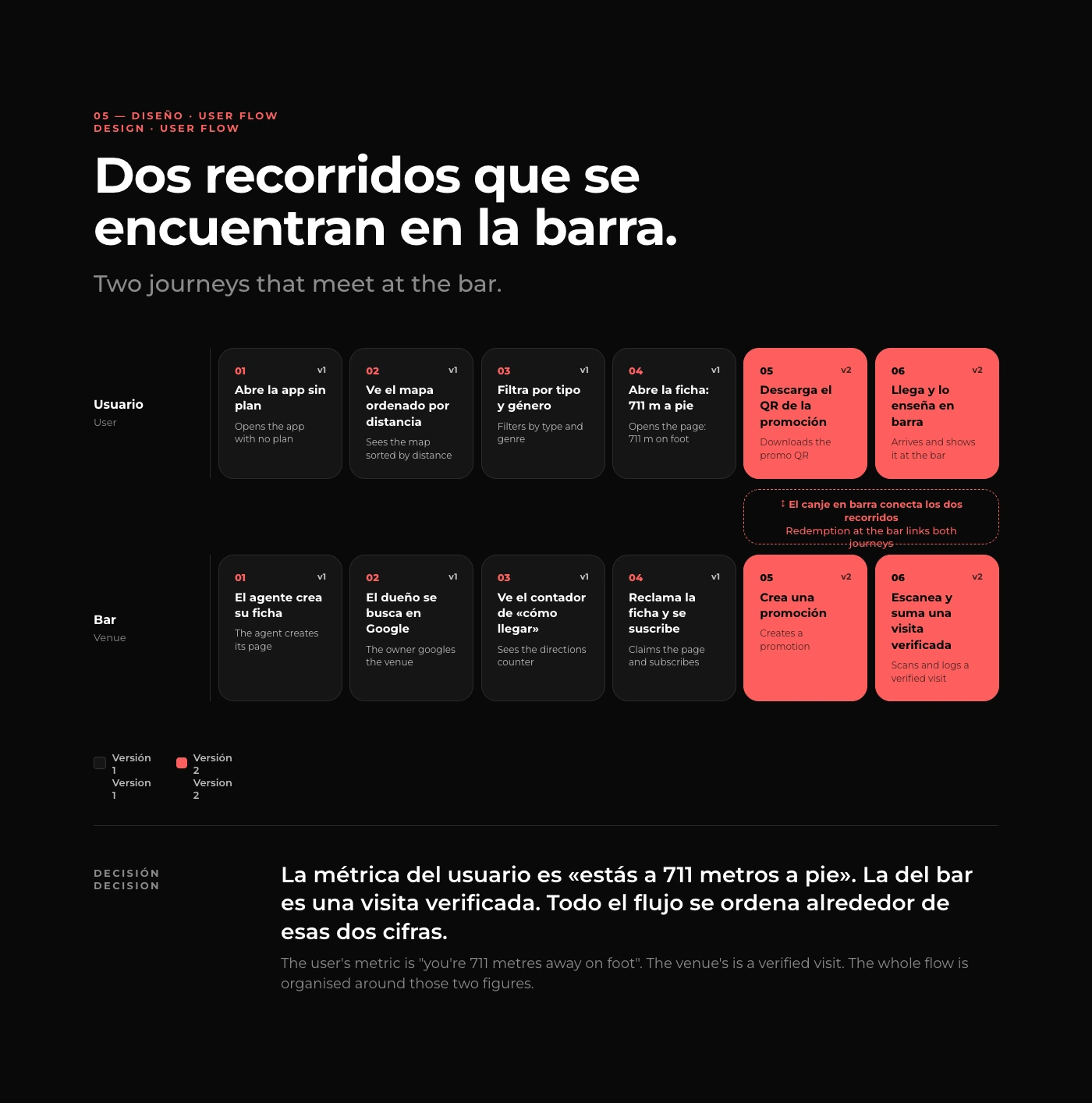
Two journeys that meet at the bar: the user with no plan and the venue that wants to prove visits.
Two journeys that meet at the bar
The user opens the app with no plan, sees the map sorted by distance, filters and opens the event page; in version 2 they download a promotion's QR and show it at the bar. The venue sees the page the agent created, claims it and, in version 2, creates promotions and logs verified visits. The user's metric is walking distance; the venue's is the verified visit.
Prototypes: Roll Vibes wireframes and final design
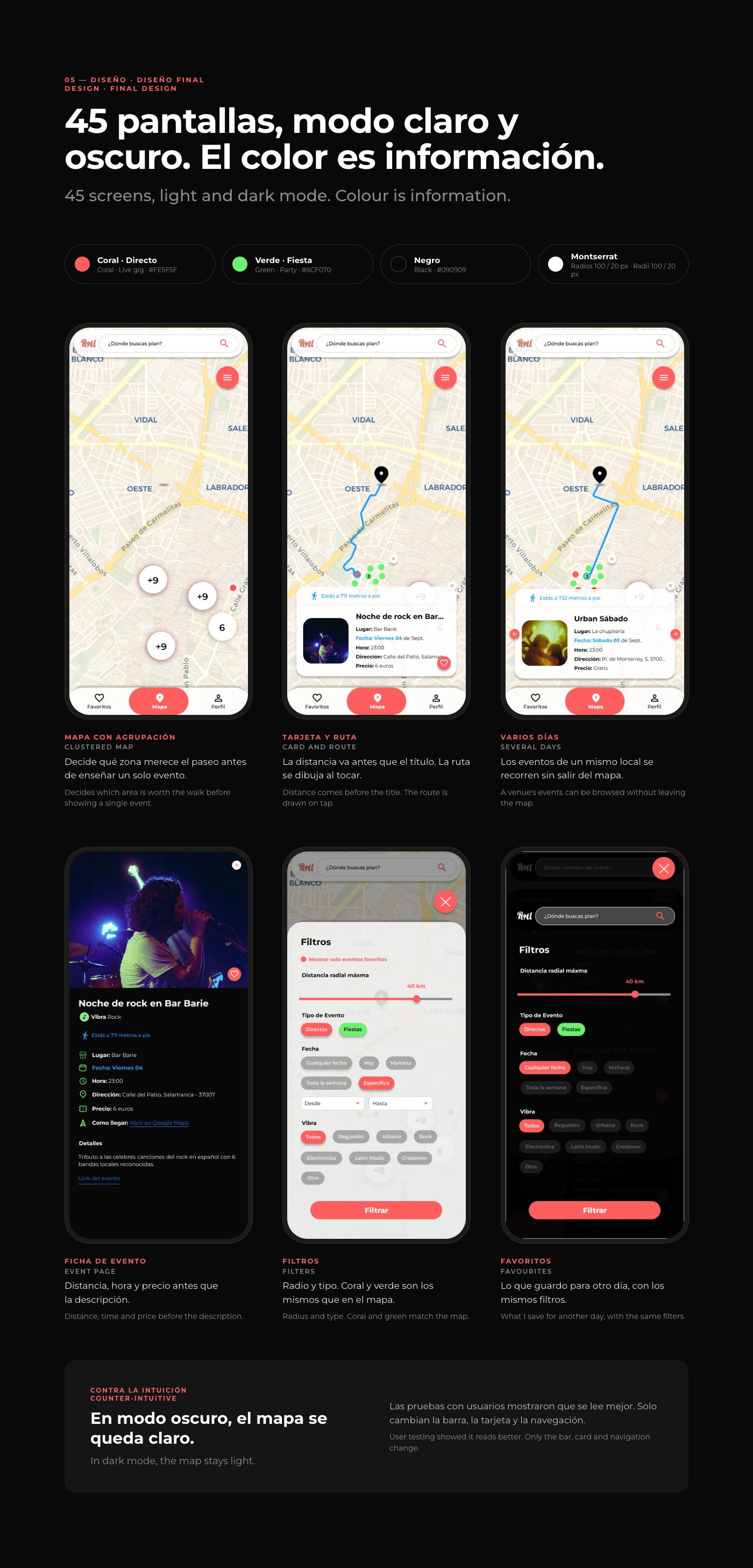
From low-fidelity sketches to 45 screens in light and dark mode.
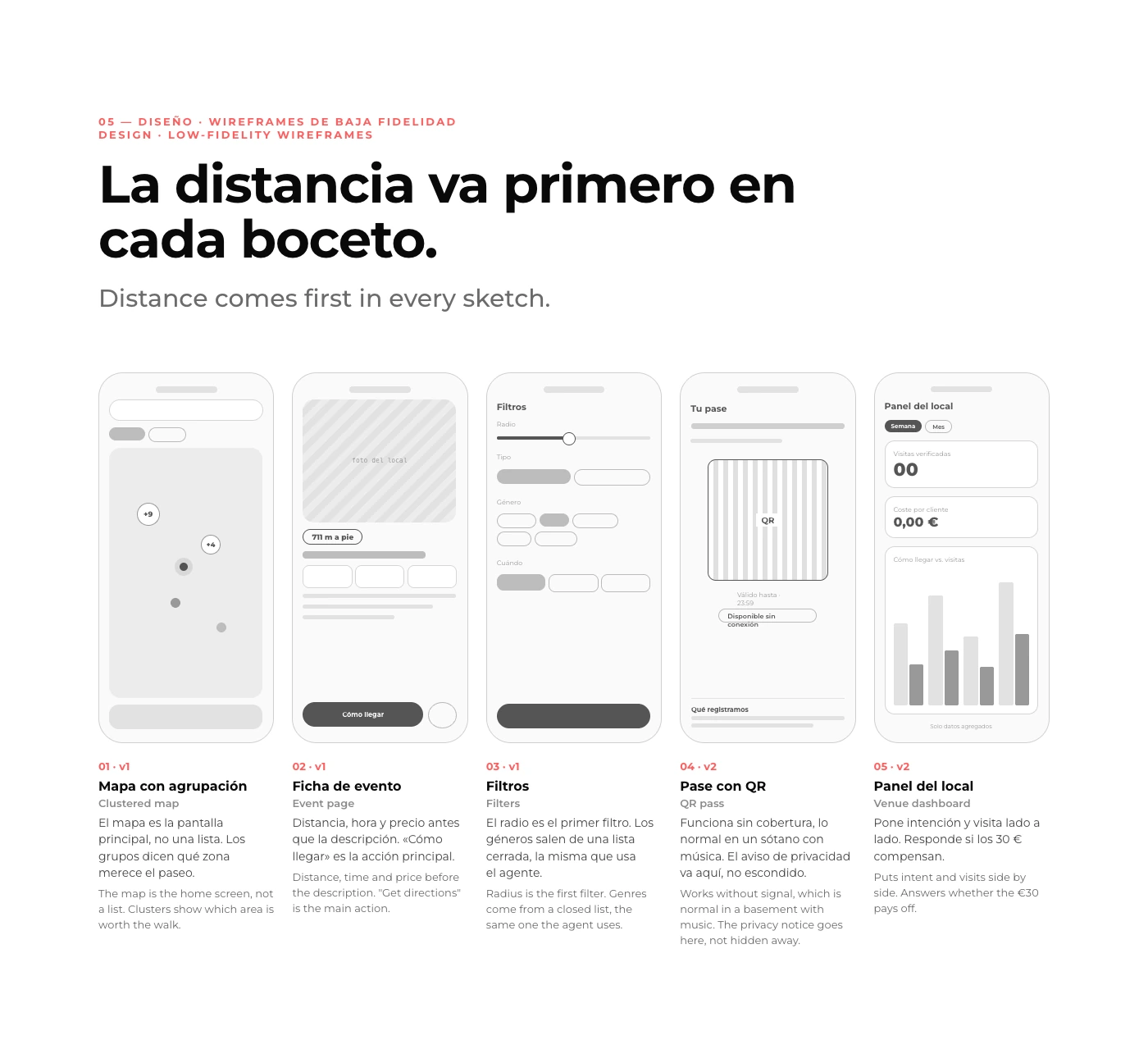
Low-fidelity wireframes
Distance comes first in every sketch: clustered map, event page, filters, QR pass and venue dashboard.
Final design
45 screens in light and dark mode, where colour is information: coral for live gigs and green for parties. User testing showed the map reads better in light even in dark mode.
Web design: Web design
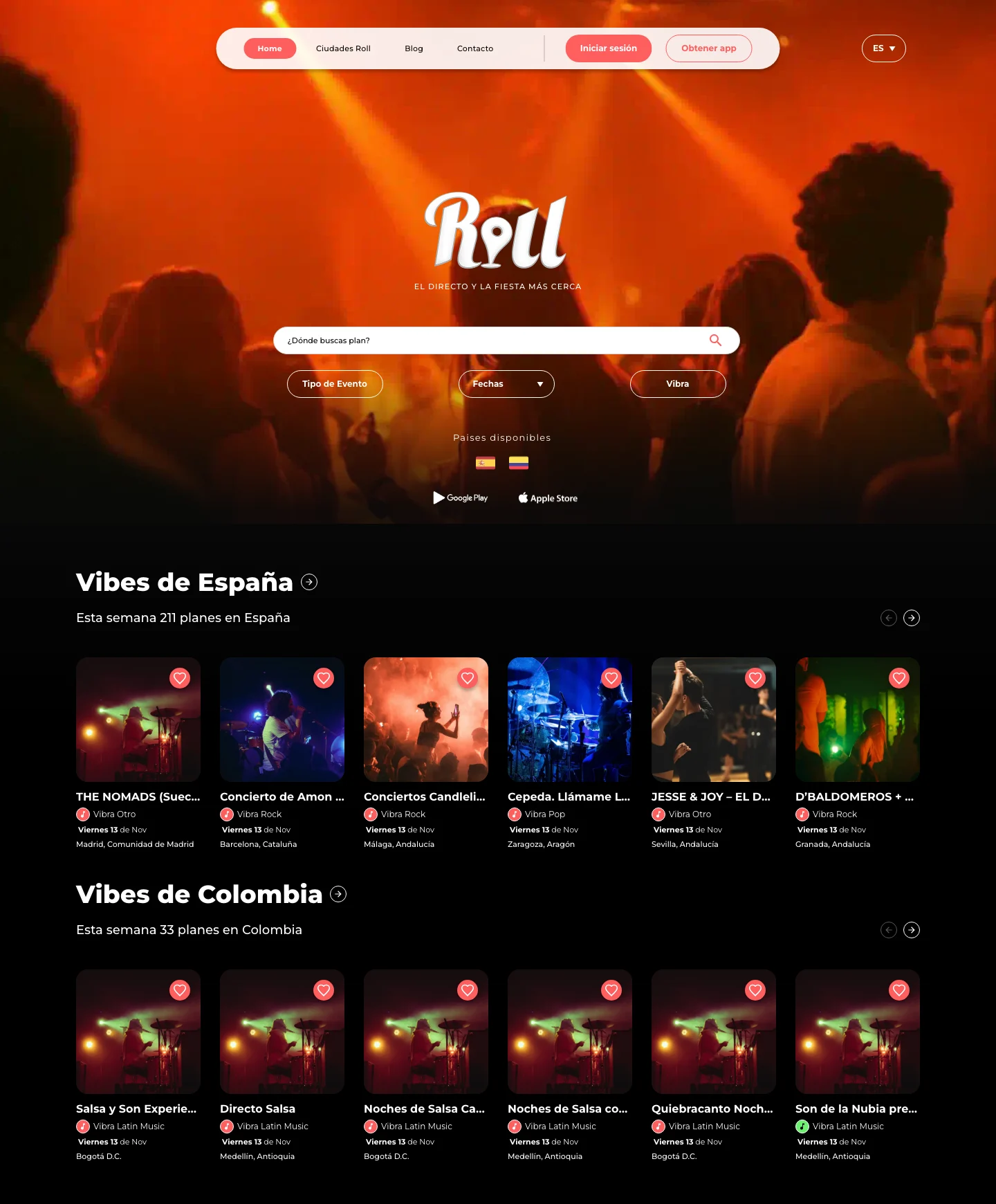
The website brings traffic from Google, turns it into downloads and helps venues find their page. The home page goes straight to search and to the plans in each country.
Home page
The website brings traffic from Google, turns it into downloads and helps venues find their page. The home page goes straight to search and to the plans in each country.
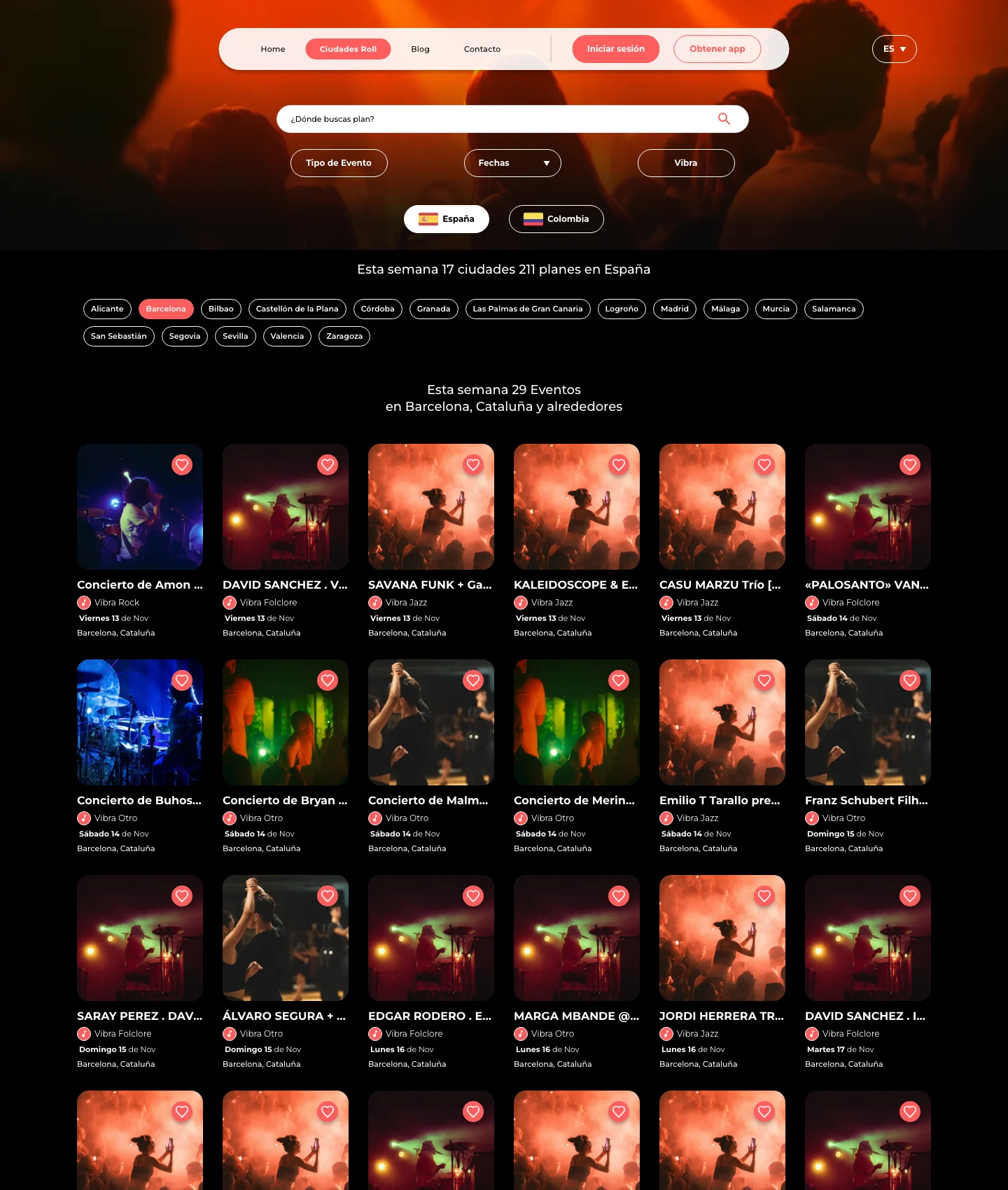
Selected city
When you pick a city, the website shows that week's events in the city and nearby.
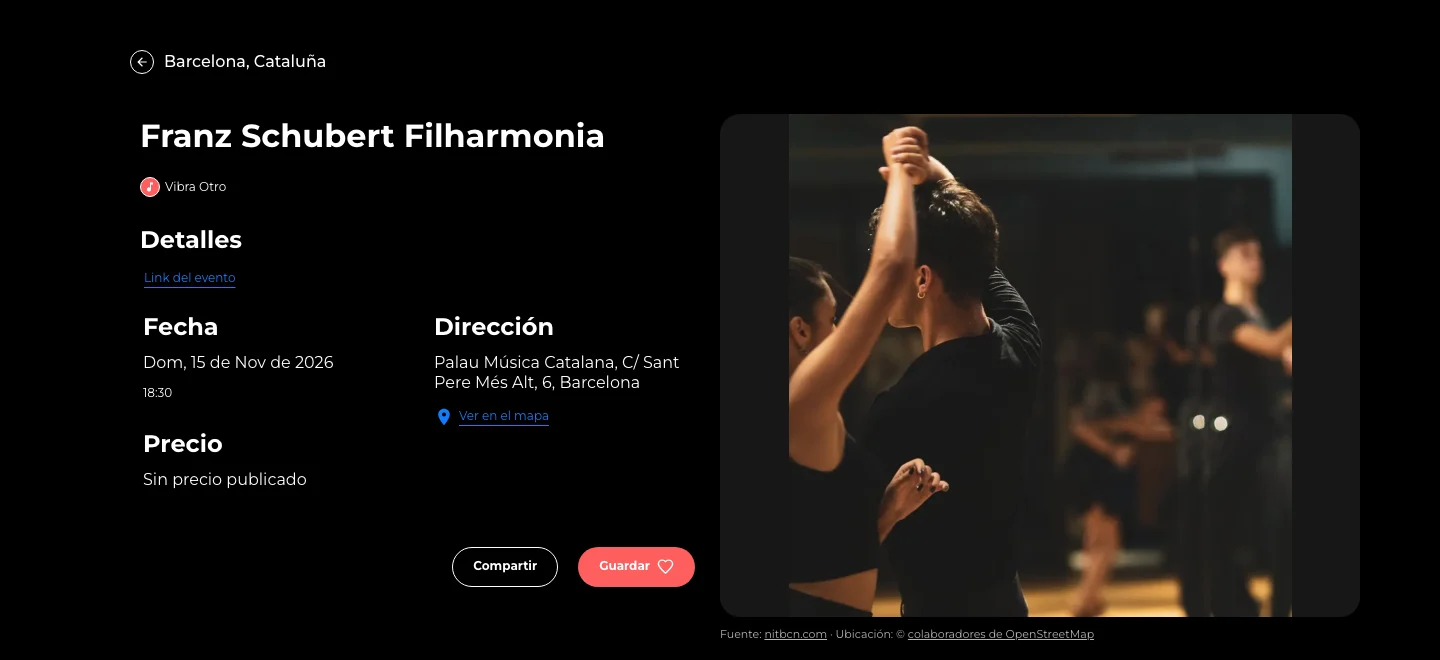
Event page
Each event has its page with date, address, directions and buttons to share and save.
Definition (PRD): Roll Vibes product definition: version 1 and version 2
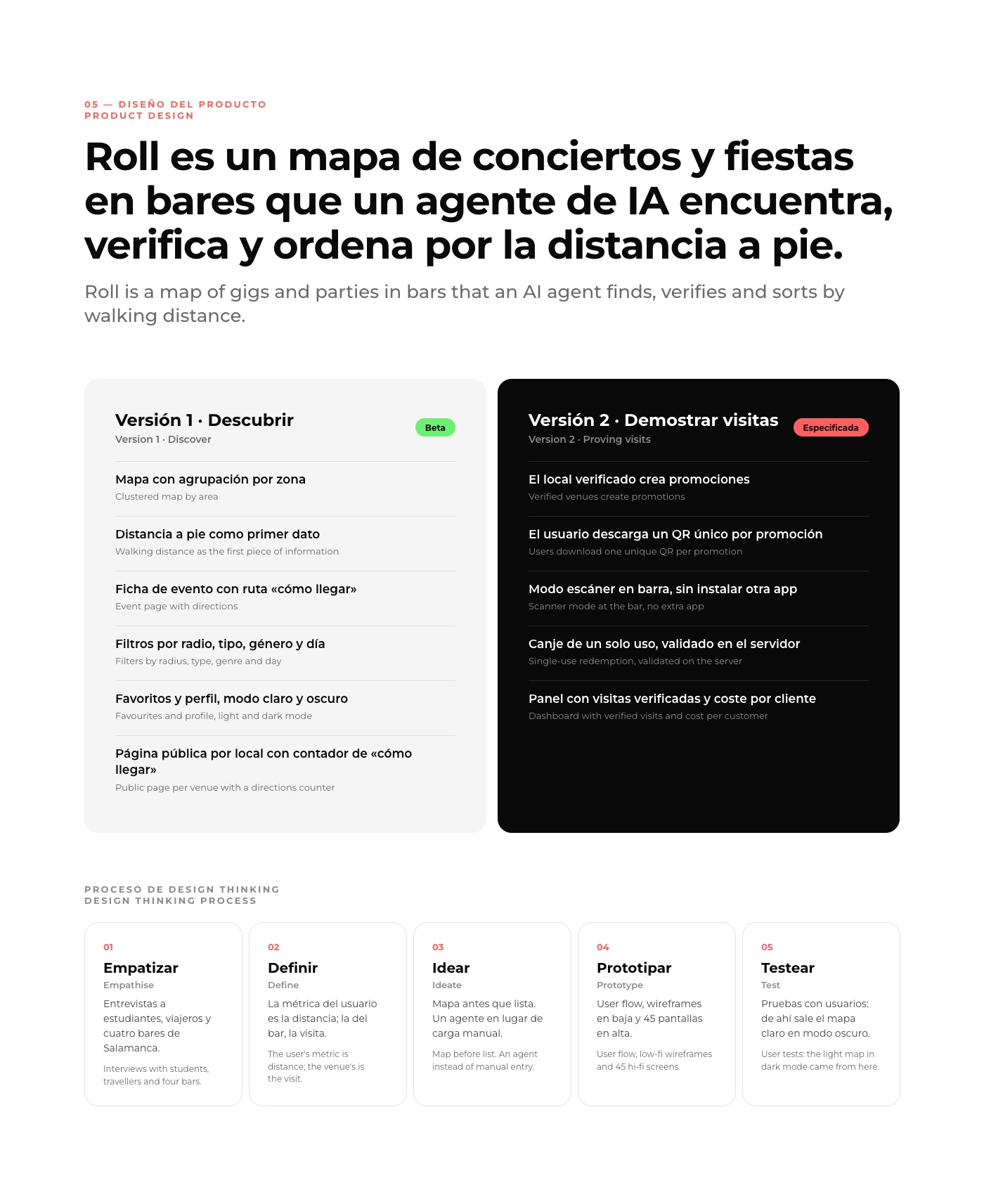
What goes into each version: discovering events (v1, in beta) and proving visits with a verified QR (v2, specified).
Version 1 and version 2
Version 1 (beta) is for discovery: a map clustered by area, walking distance as the first piece of information, an event page with directions, filters, favourites and a public page per venue. Version 2 (specified) is for proving visits: promotions from verified venues, one unique QR per promotion, scanner mode at the bar, single-use redemption validated on the server and a dashboard with verified visits and cost per customer.
Design system: Roll Vibes design system · mobile v1.1
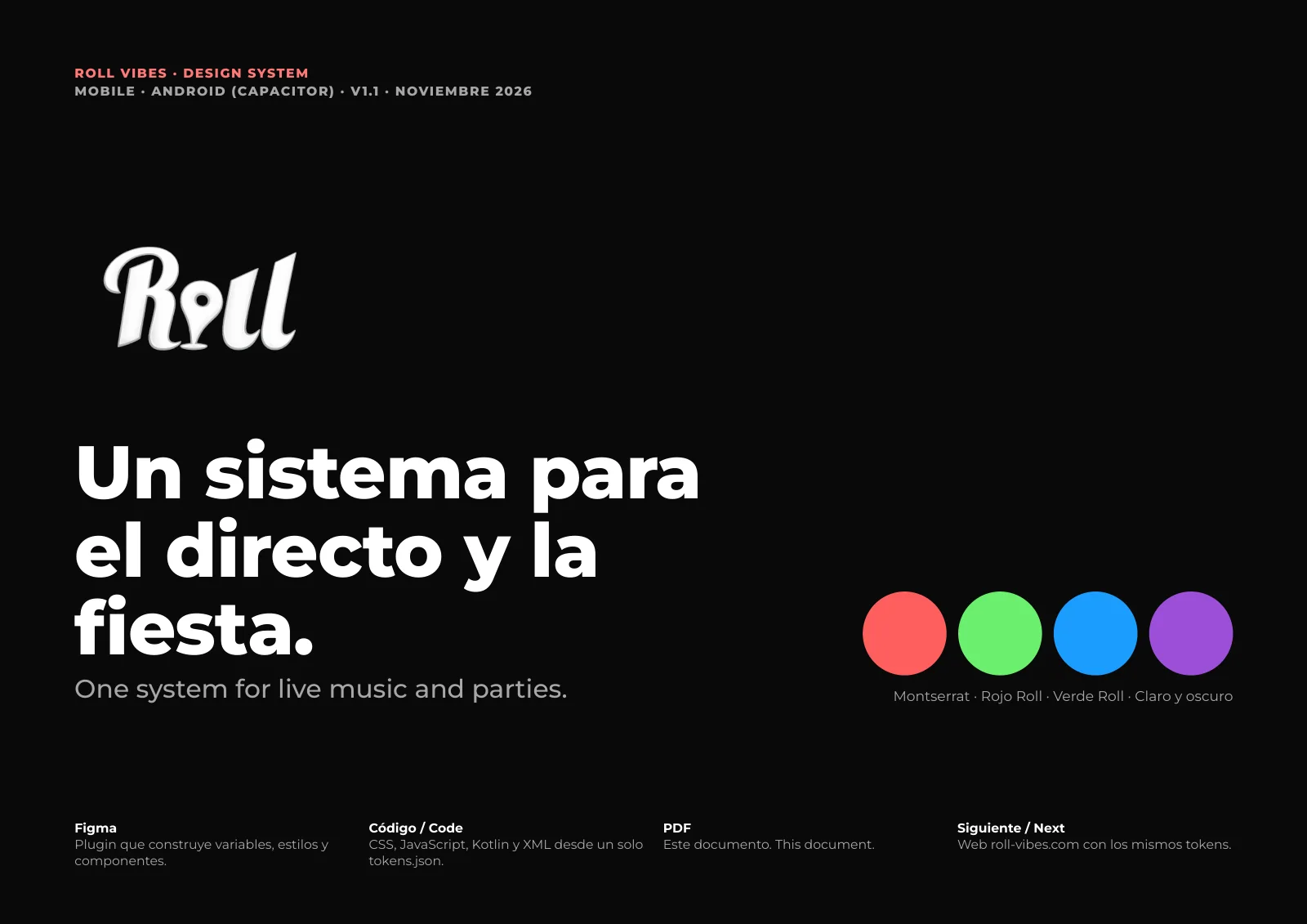
One tokens file feeds Figma, the Android app and native code, in light and dark mode.
One base, three pieces, two modes
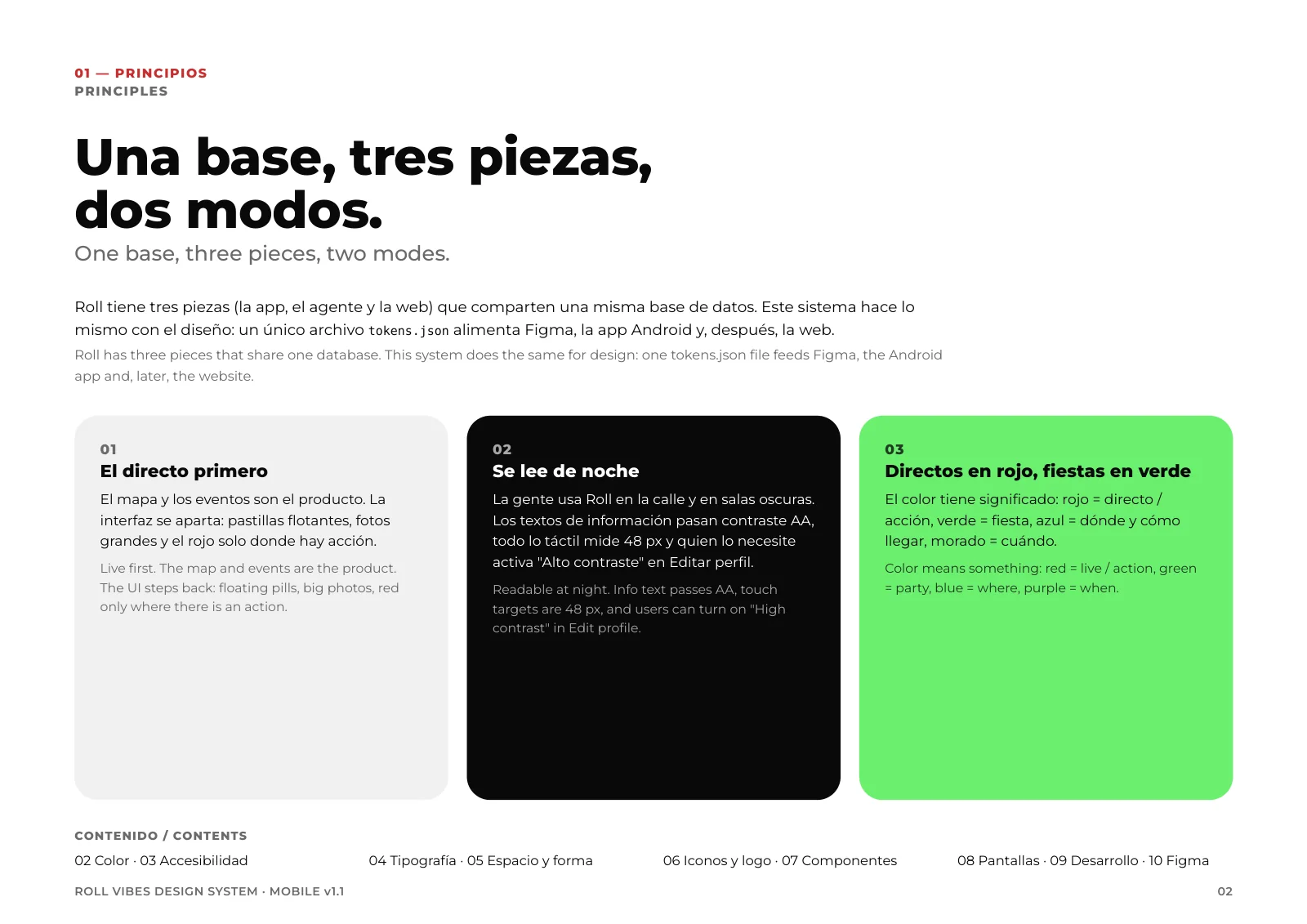
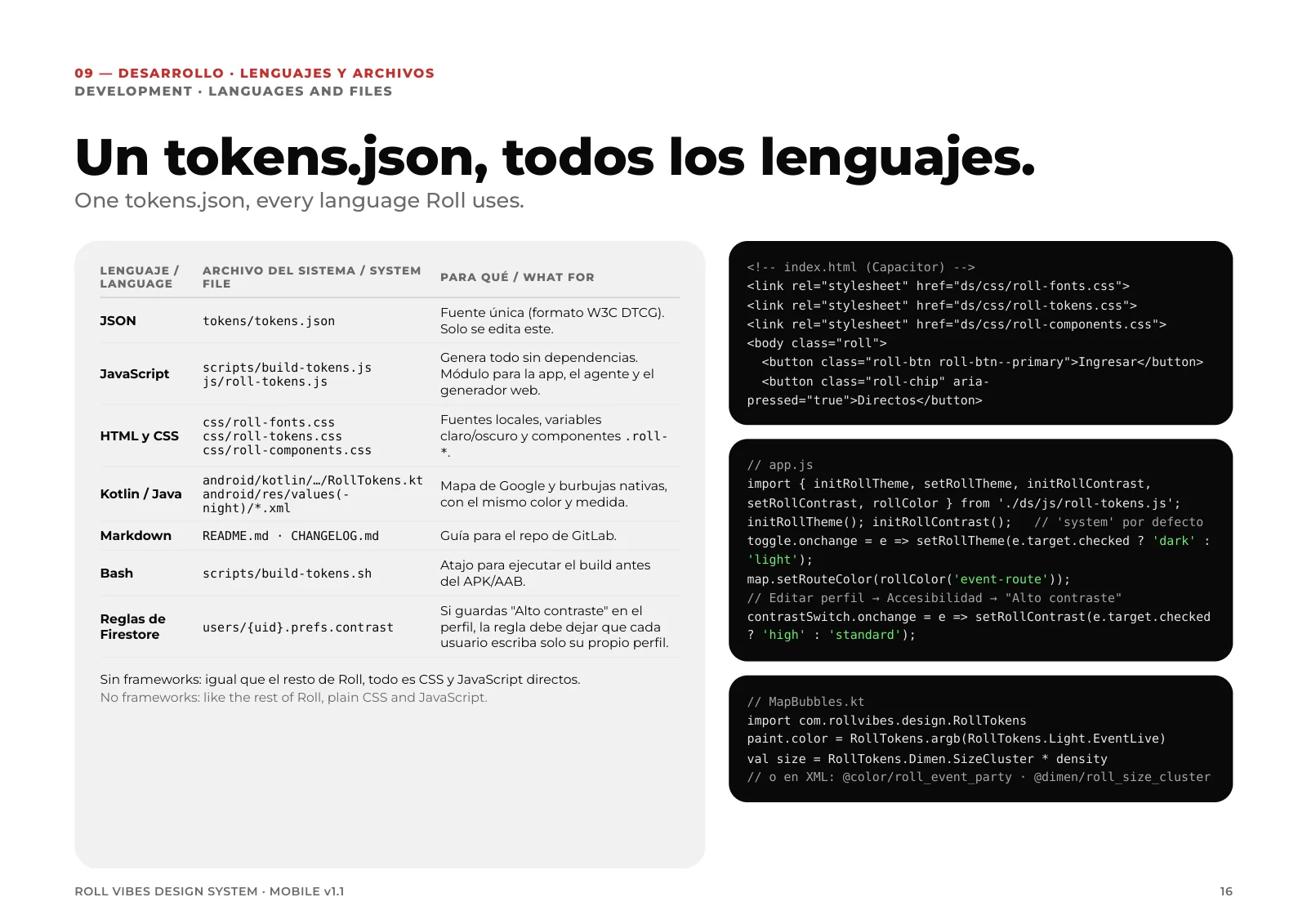
Roll has three pieces (the app, the agent and the website) that share one database. The system does the same for design: one tokens.json file (W3C DTCG format) feeds Figma, the app (Capacitor: HTML, CSS and JavaScript) and native Android code (Kotlin and XML). Principle: live first; the map and events are the product and the UI steps back.
Colour with meaning, and accessibility
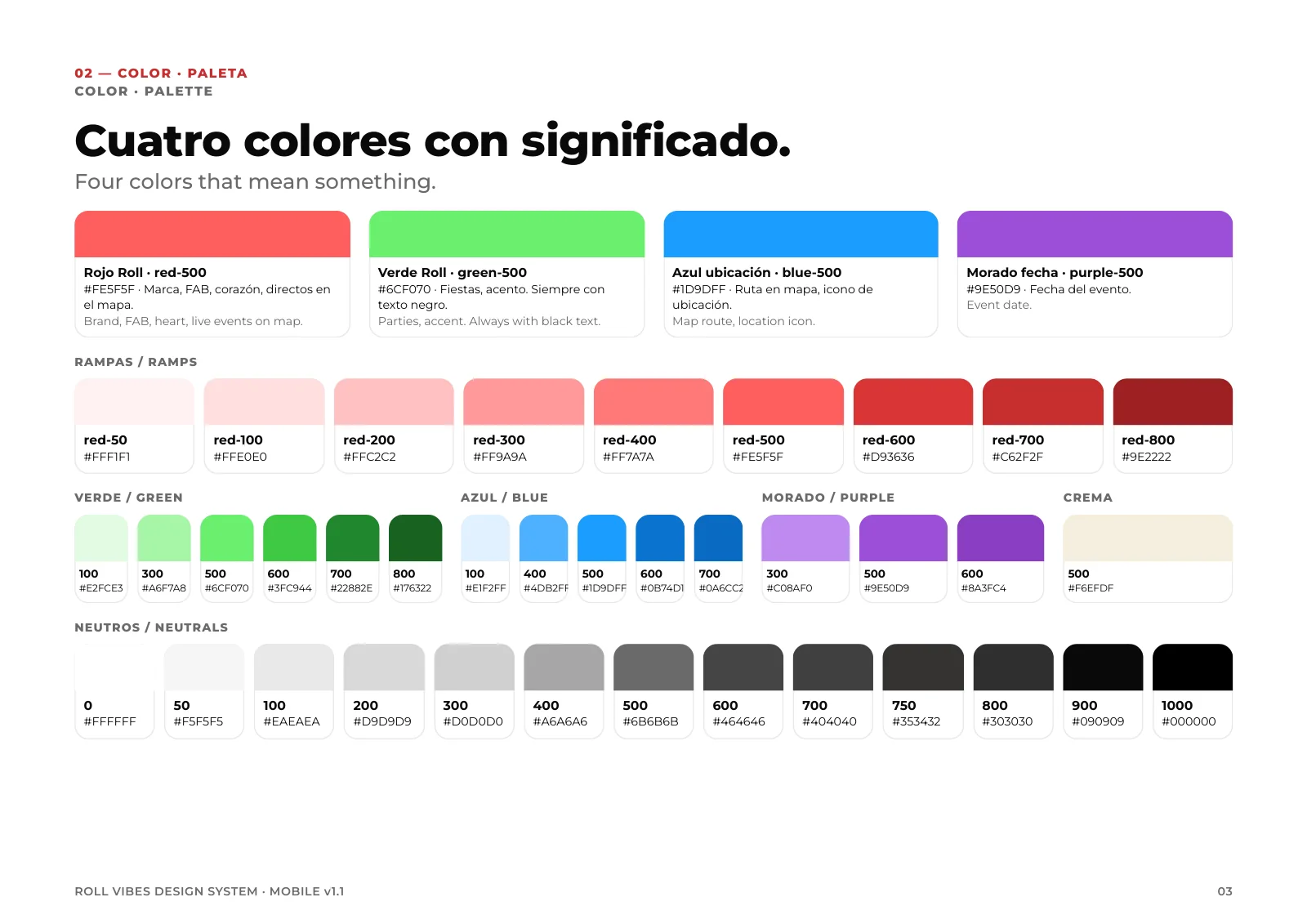
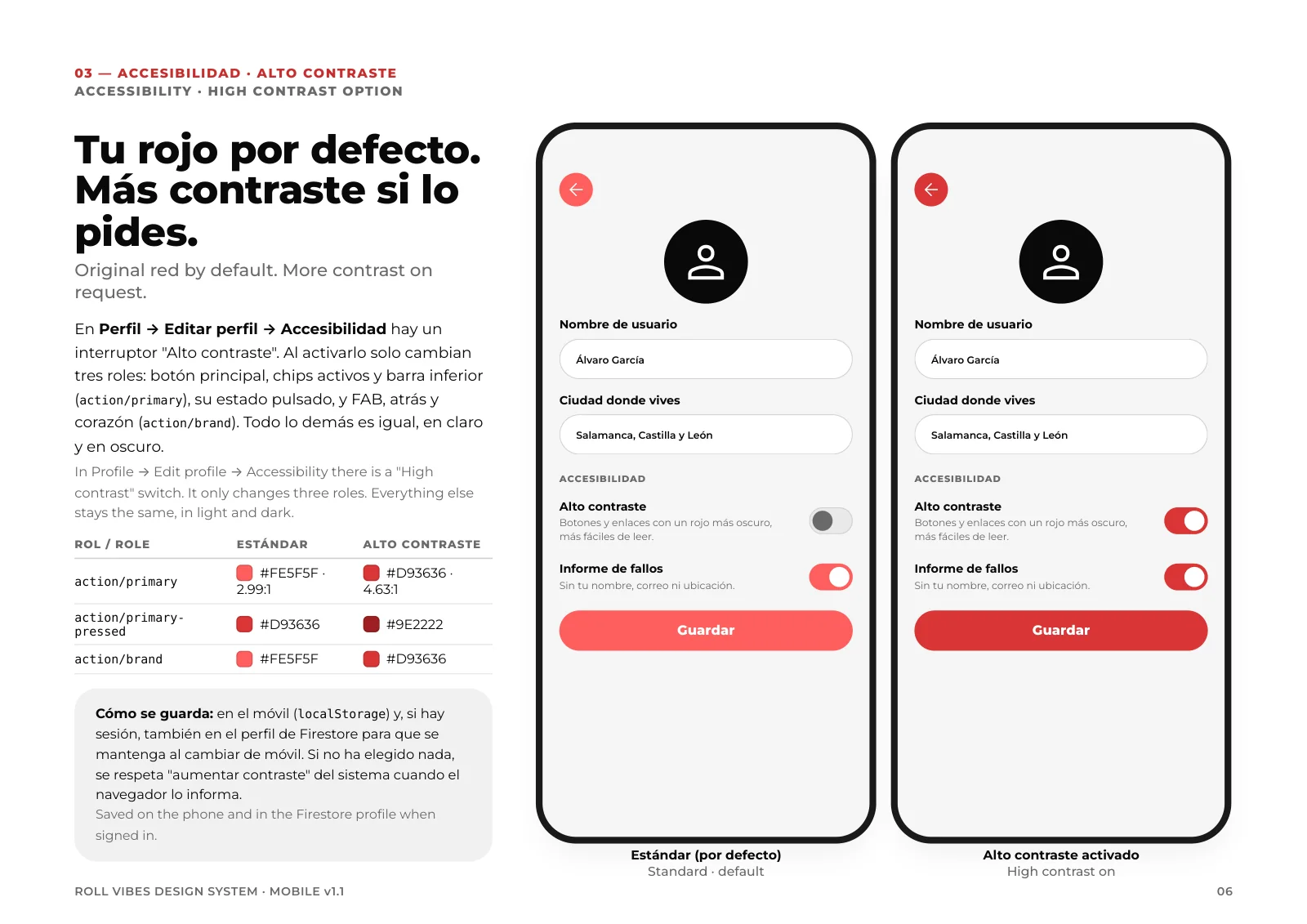
Four colours that mean something: red for the brand and live gigs, green for parties, blue for location and purple for the date. Code and Figma use role tokens, never raw colours, so dark mode works for free. Profile has a high-contrast option that only changes three roles (from 2.99:1 to 4.63:1).
Type and components
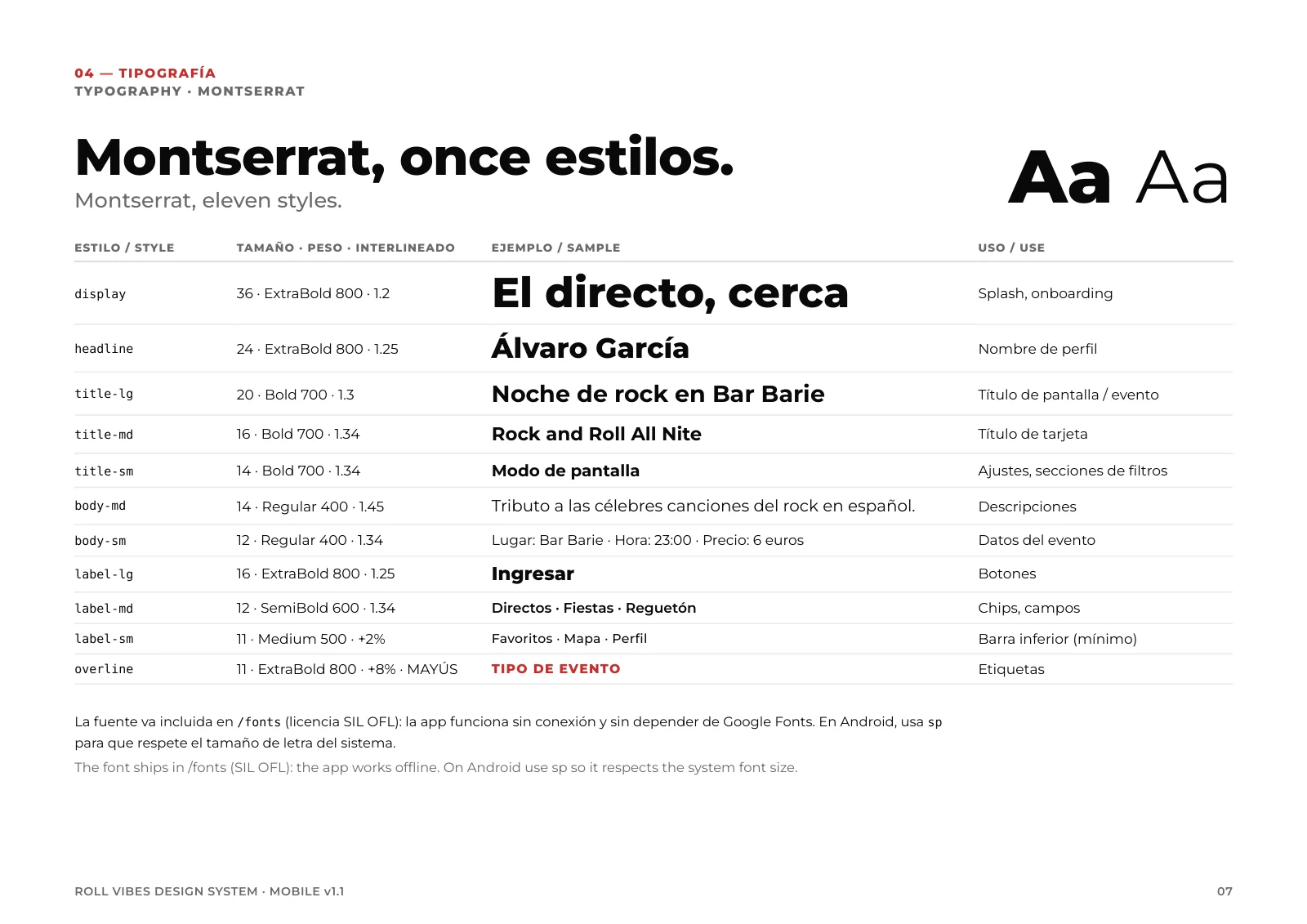
Montserrat in eleven styles. Everything is a pill, on a 4 px grid. One primary button per screen; chips in red when selected and green only for "Parties"; an event card with where, what, when and how much.
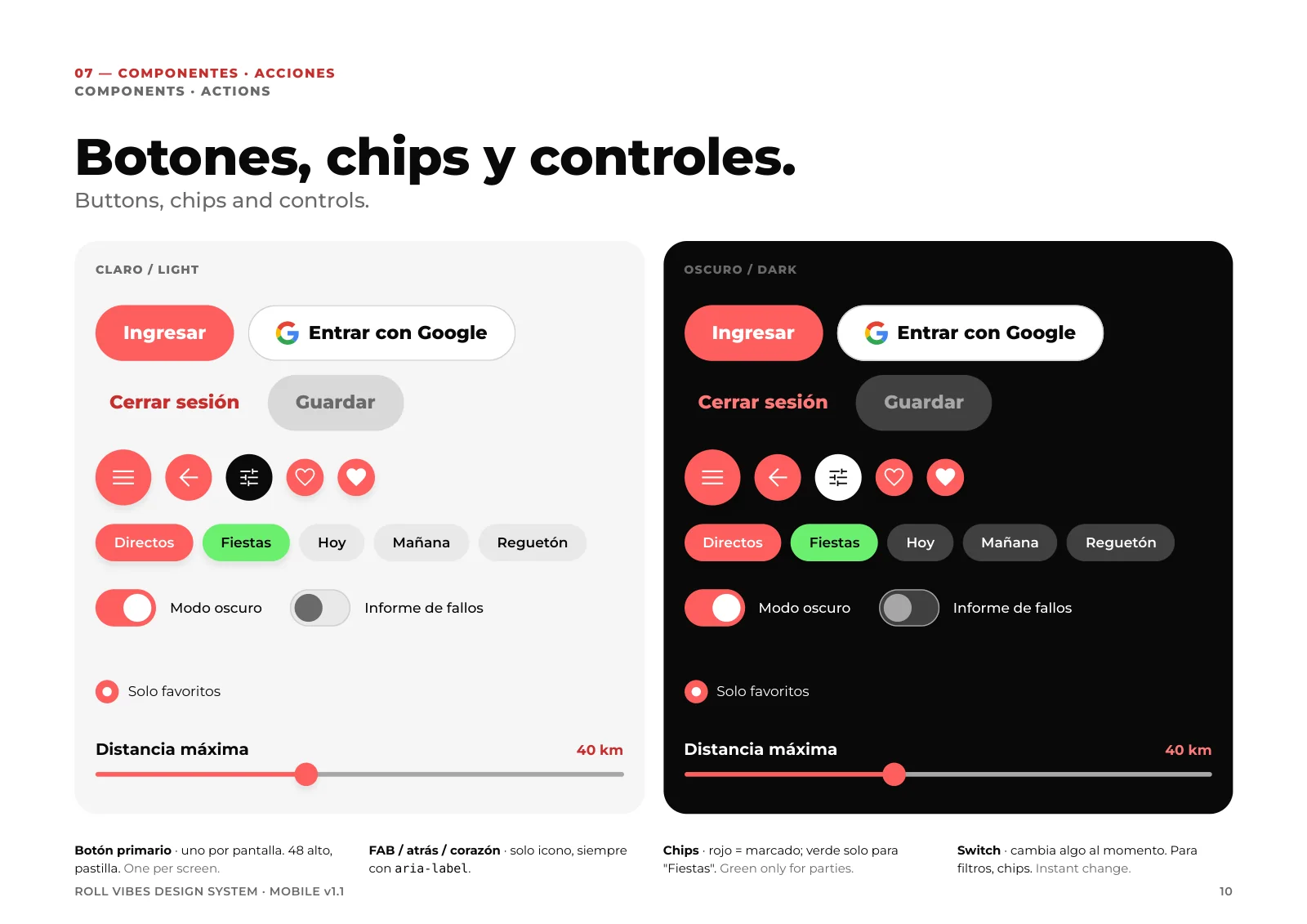
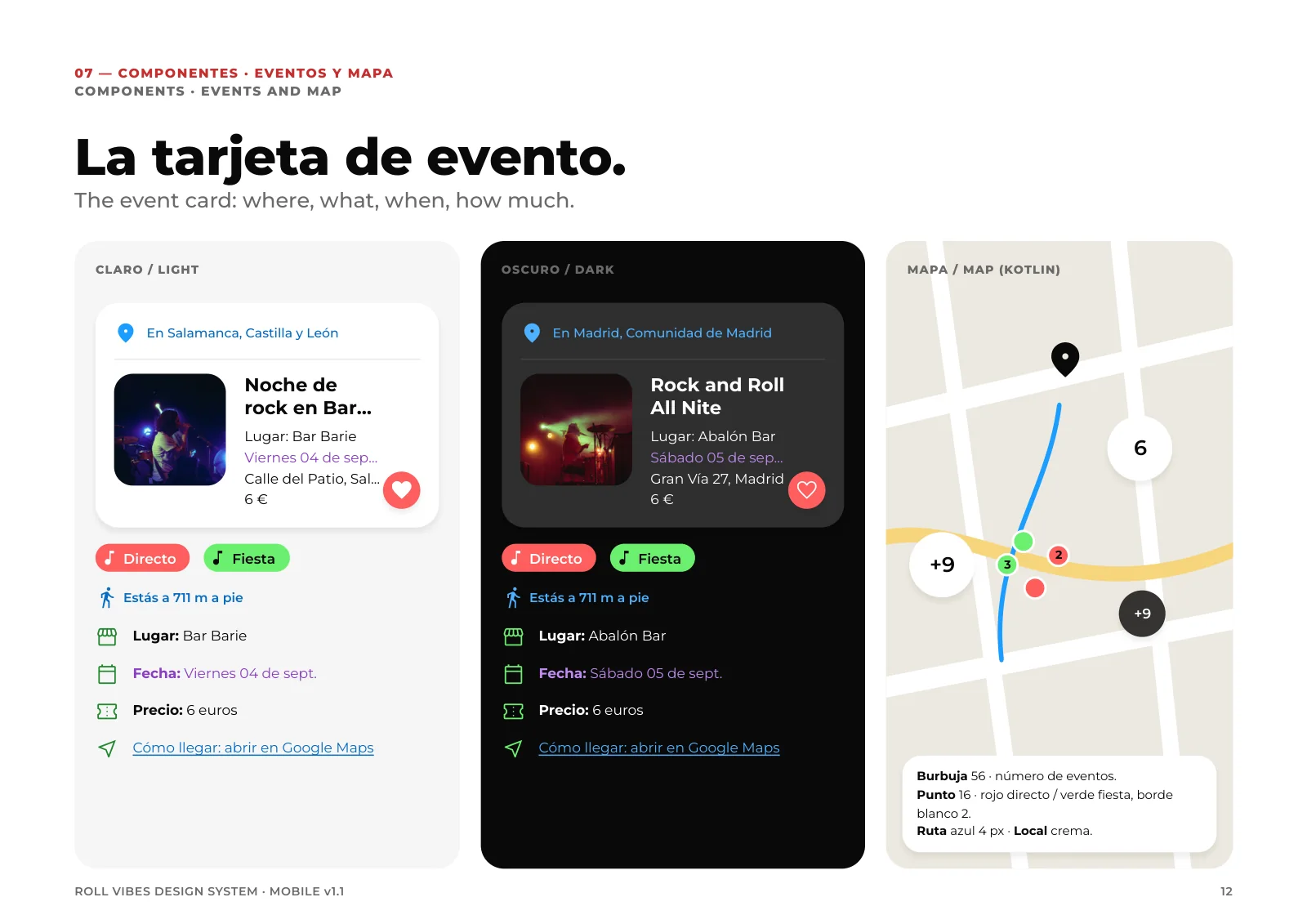
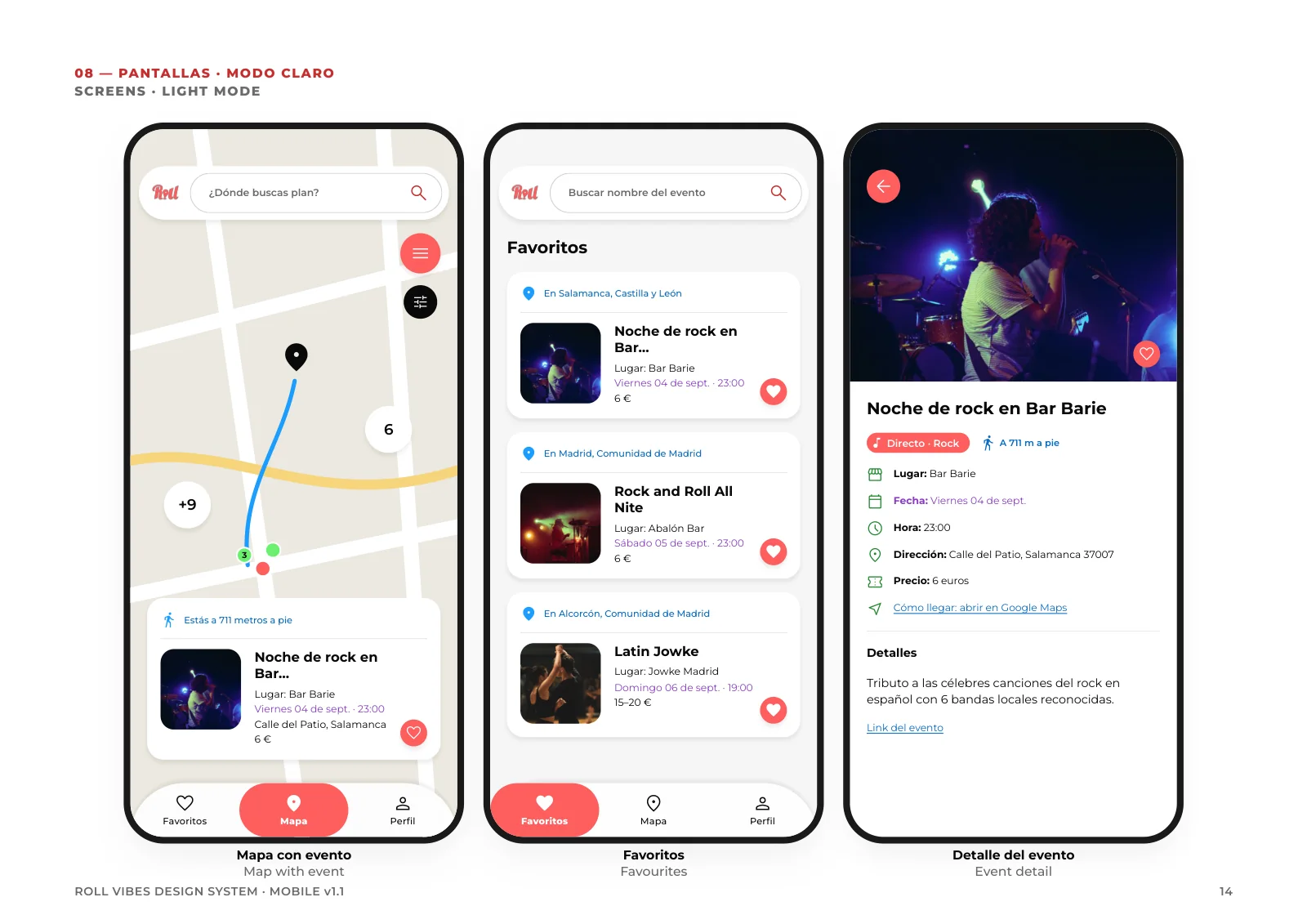
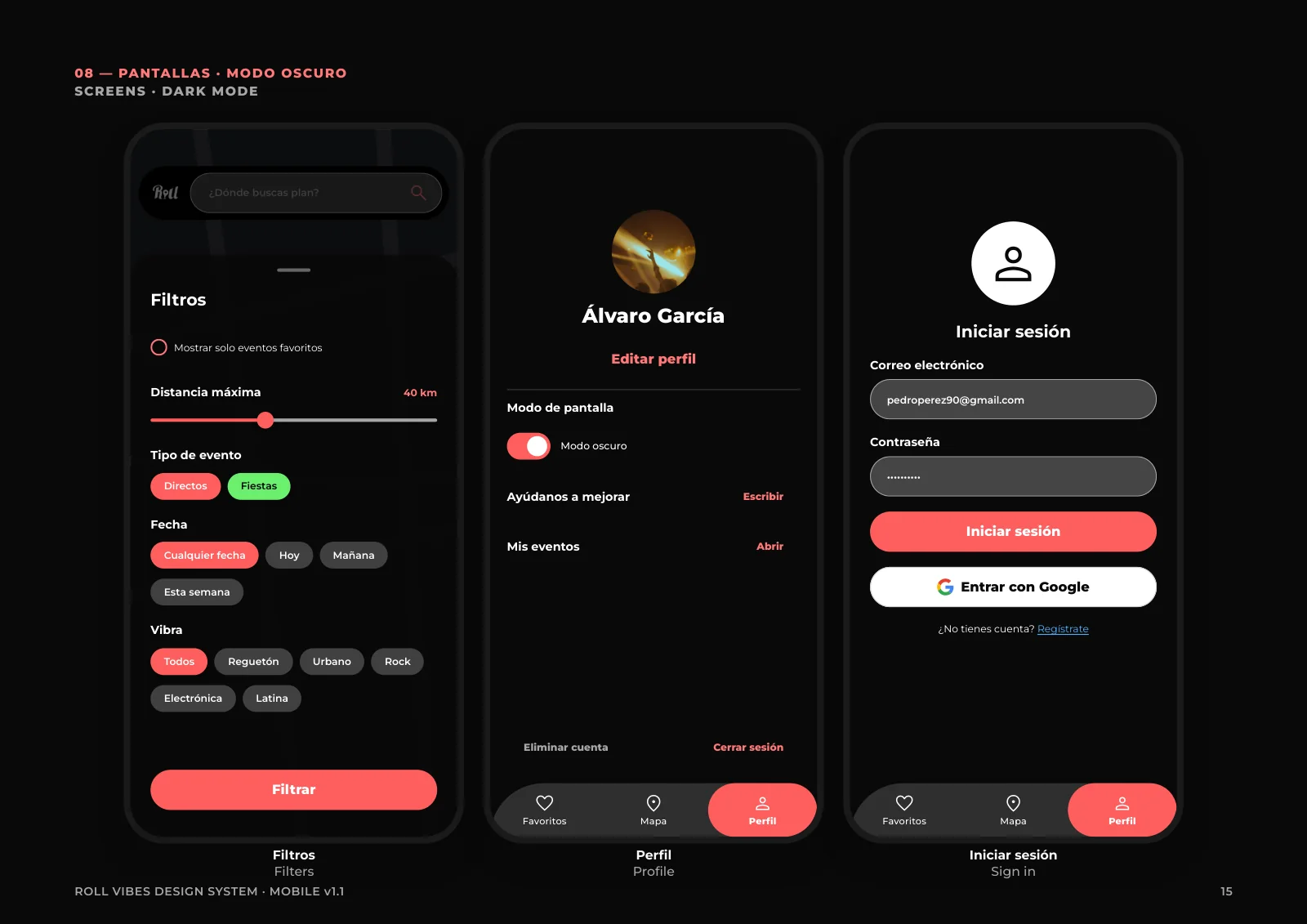
Screens and code
Light and dark mode screens come from the same system. One tokens.json becomes CSS variables, a JS module and Android resources, and a plugin builds the system in Figma.
Growth: Growth
Roll has two complementary AARRR funnels: the users, who discover plans, and the venues, who pay. Revenue is measured only in the venue funnel.
User funnel
Roll has two complementary AARRR funnels: the users, who discover plans, and the venues, who pay. Revenue is measured only in the venue funnel.
- Acquisition: Win new users · Daily content on Instagram, TikTok, Google and AI · Visits the website or downloads the app
- Activation: From first visit to Roll user · Views one or more events · Shares an event · Signs up and saves a favourite
- Retention: Come back, save and share · Opens the app or website again · Saves favourites · Shares events · Returning user
- Referral: As many promoters as possible · Rates Roll 4+ in the stores · Shares Roll so others download it · Promoters
Venue funnel
The venue joins with a free month, sees with the first redemption that Roll brings people in and, if it pays off, keeps paying and brings other venues.
- Acquisition: The venue starts its free month · Tags and one-to-one messages · "I have a venue" button · Blog and visits · Starts the free month
- Activation: It sees the value of Roll · Verifies its venue · Publishes an event · Keeps a promotion live · First redemption
- Retention: It stays because it pays off · Publishes events every month · Repeats promotions · Checks its dashboard · Active venue that stays
- Revenue: It pays after the trial · Chooses its plan when the free month ends · First payment
- Referral: It brings another venue · Answers the NPS · Shares its code · Brings another paying venue
Business: Roll Vibes market, acquisition and projections
Where to start, how to win venues (SEO and one-to-one direct sales) and a reasoned scenario from 3 pilot venues to 2,000 paying venues.
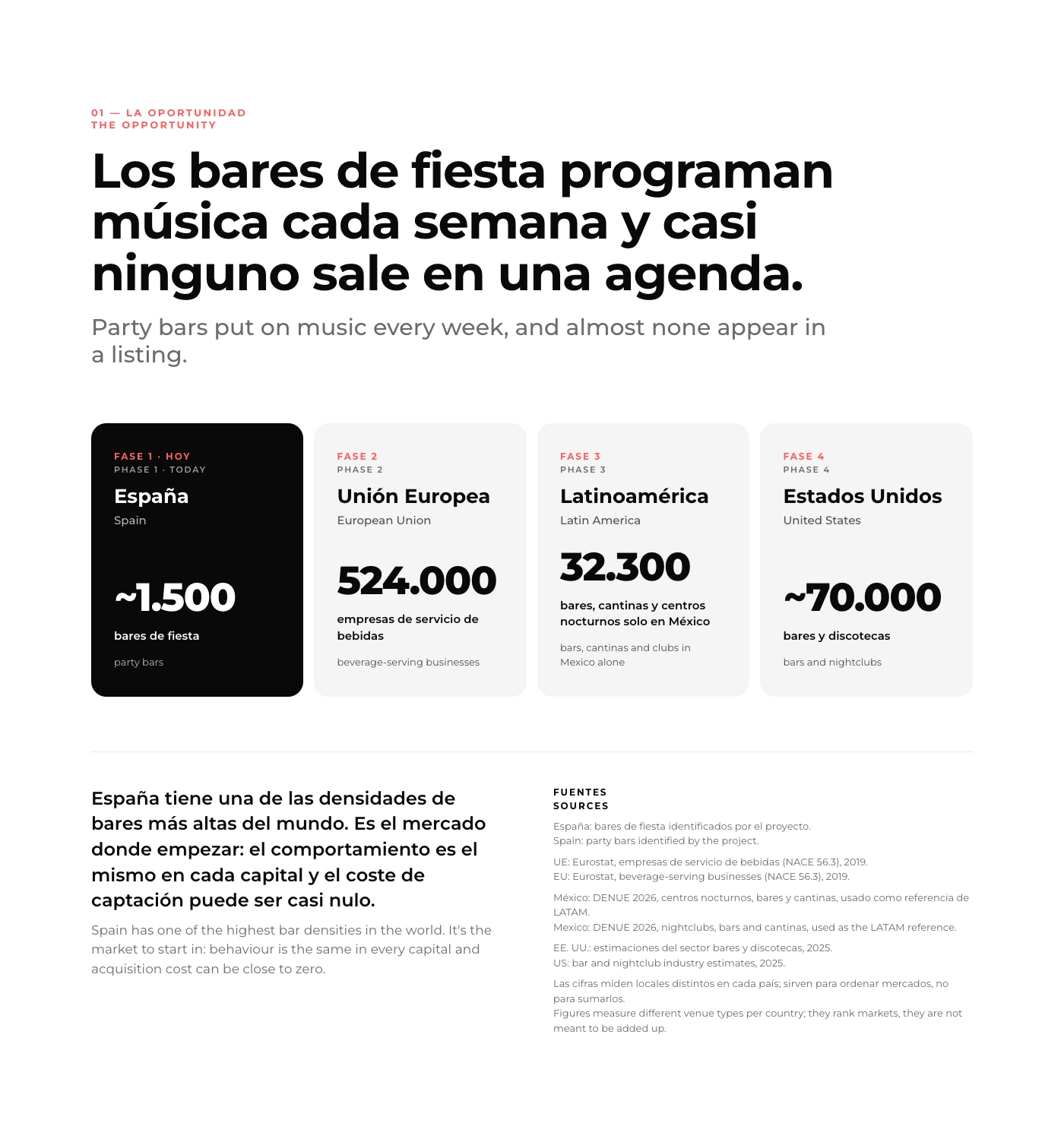
The opportunity
The market is ordered by phase: Spain, the European Union, Latin America and the United States, using public sources. Figures measure different venue types in each country: they rank markets, they are not meant to be added up.
Acquisition and projections
Two engines that reinforce each other: SEO brings in users and venues continuously and one-to-one direct sales (messages, tags and visits) turn that attention into paying customers in the first cities. Compliance from the start: no data is extracted from social networks or Google Maps. Calculation: venues × €30 a month × 12.
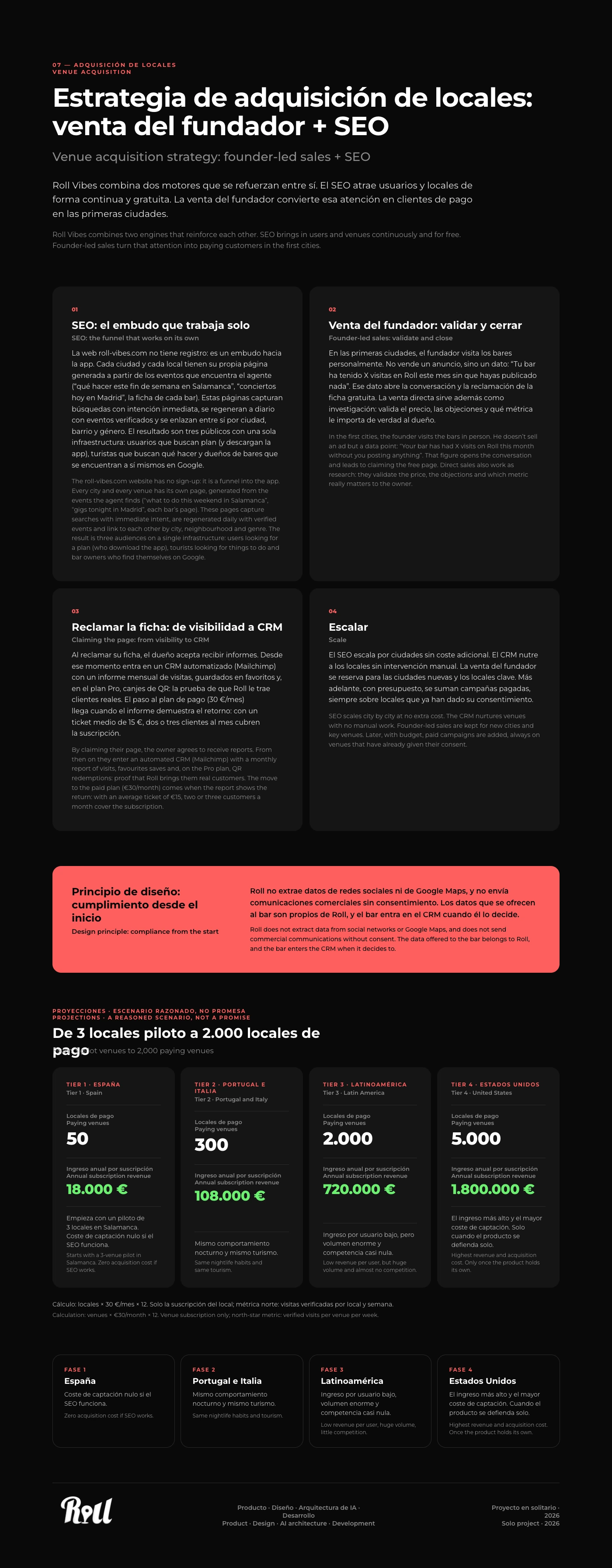
Projections are a reasoned scenario, not a promise or a result.
Agentic AI: Agentic AI
An AI agent collects events from bars and clubs from public sources so nobody has to search several sites. This is its design map.
The Roll agent
An AI agent collects events from bars and clubs from public sources so nobody has to search several sites. This is its design map.
- Public sources: Websites and listings of bars, live venues and clubs
- Collects: The agent finds and classifies events
- Publishes: In the app and on the website, by city
- The venue: Sees the page the agent created and claims it
- The user: Discovers plans nearby without searching several sites
A team of agents
Roll is run with a team of AI agents. Each agent covers one area, works only with that area's information and none of them publishes, sends or deletes anything without human approval. They work in a weekly cycle, with one board per area and a wrap-up every Friday.
- Teo: Coordination and security · Organises the work, reviews risks and classifies information.
- Rafa: Technology · Builds the app and the website following the approved specs.
- Ana: Quality · Tests every change against its acceptance criteria before release.
- Lucía: Marketing and content · Prepares content, social media and acquisition campaigns.
- Raúl: Data and research · Measures results and prepares analyses and research.
- Mr. Vibes: Presenter · An AI-created character who presents each city's plans on video.